

People often ask me what it feels like to wake up each morning knowing your office is the Tenerife sky. The honest answer is that, after more than 25 years flying, the thrill never fades — it simply deepens into something more meaningful: responsibility, precision, and the quiet satisfaction of knowing that every flight I do with Brisa will change the day — and perhaps something more — for the person flying alongside me.
Here, from the inside, is what a working day actually looks like when you’re a tandem paragliding instructor pilot in the south of Tenerife.
Coffee and Trade Winds: When the Day Starts Before Dawn
My day doesn’t begin at the launch site. It begins long before, with a cup of coffee in hand and several screens in front of me.
The first thing I do every morning is the weather briefing. I check wind maps from the local stations, analyse the position of the thermal inversion layer — that invisible ceiling the trade winds build over the Canary Islands, which perfectly defines the usable flight altitude — and review the thermal gradient to anticipate when the rising air currents will activate on the slopes of Taucho.
The trade winds are the heartbeat of flying in Tenerife. When they blow steadily, they act as an invisible engine guaranteeing stable conditions for hours at a time. Mount Teide, with its imposing mass, acts as a natural barrier to the north-easterly flows, creating a leeward zone in the south of the island that favours the calm, extended gliding our passengers enjoy so much. Reading that behaviour isn’t something you learn from a book — it’s the result of years flying this particular landscape.
If conditions are favourable, the rest of the Brisa team springs into action. We coordinate the pick-up logistics from Costa Adeje, Los Cristianos, and Playa de las Américas, and plan the order of the day’s groups.
On the Way to Taucho: Breaking the Ice with Passengers
The Brisa vans collect passengers directly from their accommodation. That journey up to Taucho — roughly 20 minutes winding along the southern hillsides — is already part of the experience.
I use that time to do something I consider just as important as any technical manoeuvre: getting to know the person who’s about to fly with me.
Once at the launch point, the passenger briefing begins. I explain clearly and warmly what those first running steps at take-off will feel like, what sensations they’ll notice as they lift off, and how to relax their body to get the most from the flight. No previous experience or special physical preparation is needed. My job is to ensure that the moment their feet leave the ground, the only thing my passenger feels is wonder.
Just before we launch, I carry out the pre-flight inspection. I check every line of the suspension system for tangles or wear, verify the condition of all the carabiners, and confirm the position of the emergency parachute deployment handle. This equipment is certified and approved to the most stringent international standards, and its preventive maintenance is non-negotiable at Brisa. A pilot doesn’t improvise in the air — they build their confidence on the ground.
In the Air: The Responsibility of a Tandem Pilot Above the Barranco del Infierno
The take-off at Taucho is one of those moments that never stops impressing me, even after living it thousands of times. Three running steps, the wing inflates above our heads, and suddenly the ground disappears beneath our feet.
From that instant, my attention is split between two simultaneous fronts: the airspace and the passenger’s experience.
On the airspace side, I always fly respecting the established control zones. Coordination with the CTR (controlled airspace) is part of the daily protocol, not an exception. Knowing exactly where the altitude limit lies and how to make the most of the anabatic currents — those breezes that rise along the sun-warmed hillsides — is what allows us to extend the flight with complete peace of mind.
On the passenger side, my quiet work is to read them. If I sense they’re tense, I soften the manoeuvres and invite them to look towards the horizon, where the silhouette of La Gomera floats above the Atlantic like a postcard. If they’re euphoric and want more, I can tilt the wing gently so they feel the controlled rush of a smooth spiral above the turquoise blue of the Costa Adeje coastline.
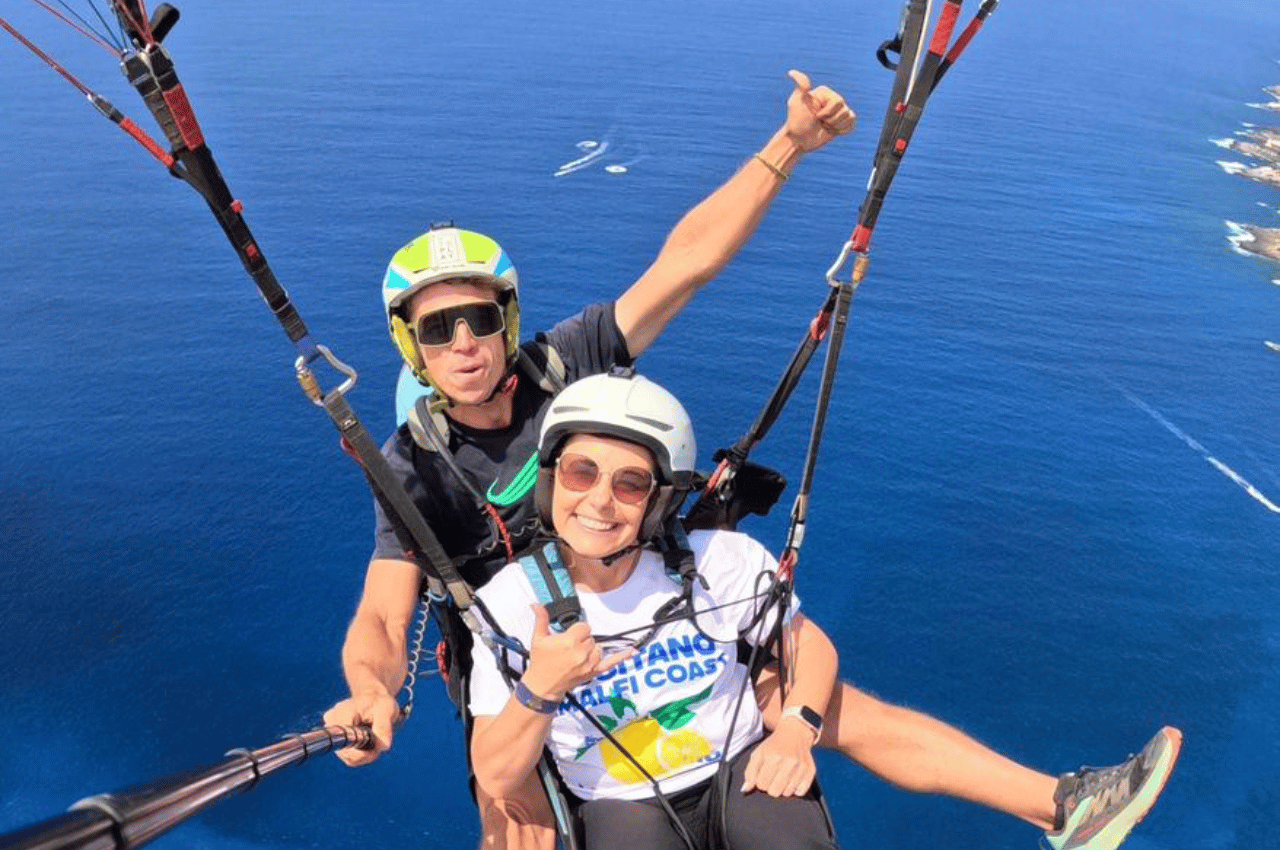
Beneath our feet, the dramatic depth of the Barranco del Infierno opens up like a scar millions of years in the making. That view from the air — with Teide presiding over the horizon behind us — is something no photograph can ever fully capture.
The minutes in the air pass far too quickly. They always do.
Landing at Playa de La Enramada
We touch down on the sand at Playa de La Enramada, in La Caleta, with the gentleness that controlled gliding over the shoreline allows. The landing is, more often than not, the moment when passengers finally find the words they couldn’t say in the air.
While I pack away the wing — a methodical process that also serves to check for any issues with the equipment — I talk with my passenger about what they’ve just experienced. That feedback is genuinely valuable: it helps me keep improving the experience and, in many cases, it’s the origin of a review that will help other travellers make up their minds.
Depending on the day, this cycle repeats several times. Up to Taucho, prepare the kit, fly, land, pack up.
Ready to Take the Other Seat?
At Brisa, we don’t carry passengers — we accompany people through one of the most extraordinary moments of their lives. Everything in that routine I’ve just described serves a single purpose: so that when you land on the sand at La Enramada, you feel as though the Tenerife sky was always yours.
You can book your flight today via WhatsApp or through our booking form. We fly all year round and collect directly from your accommodation in Costa Adeje.
Frequently Asked Questions About the Work of a Paragliding Pilot in Tenerife
How many flights does a professional paragliding pilot do in a day in Tenerife?
On a full day with good conditions, an active tandem pilot can complete between 3 and 5 flights. Each flight includes the transfer, equipment preparation, and pre-flight inspection, so the working day far exceeds the pure flying time.
What qualifications does a pilot need to carry passengers on a tandem paraglider?
In Spain, a tandem instructor pilot must hold the Técnico Deportivo en Parapente qualification along with the specific endorsement for tandem flights. At Brisa, all our pilots additionally hold APPI international certifications and FAI IPPI recognition, guaranteeing the highest industry standards.
How does the pilot know whether conditions are safe to fly on a given day?
The decision always starts with the morning weather briefing. We analyse the position of the thermal inversion layer, the direction and strength of the trade winds, and the anabatic and katabatic breeze cycle on the hillsides. If any of those parameters falls short of our quality standards, the day is postponed or adjusted. At Brisa, flying well always takes priority over flying at any cost.
What happens if conditions aren’t suitable on the day of my flight?
Brisa’s commitment to every passenger includes full flexibility to change the date at no extra charge. Nature is in charge, and respecting that is part of our philosophy of responsible active tourism in the Canary Islands.