


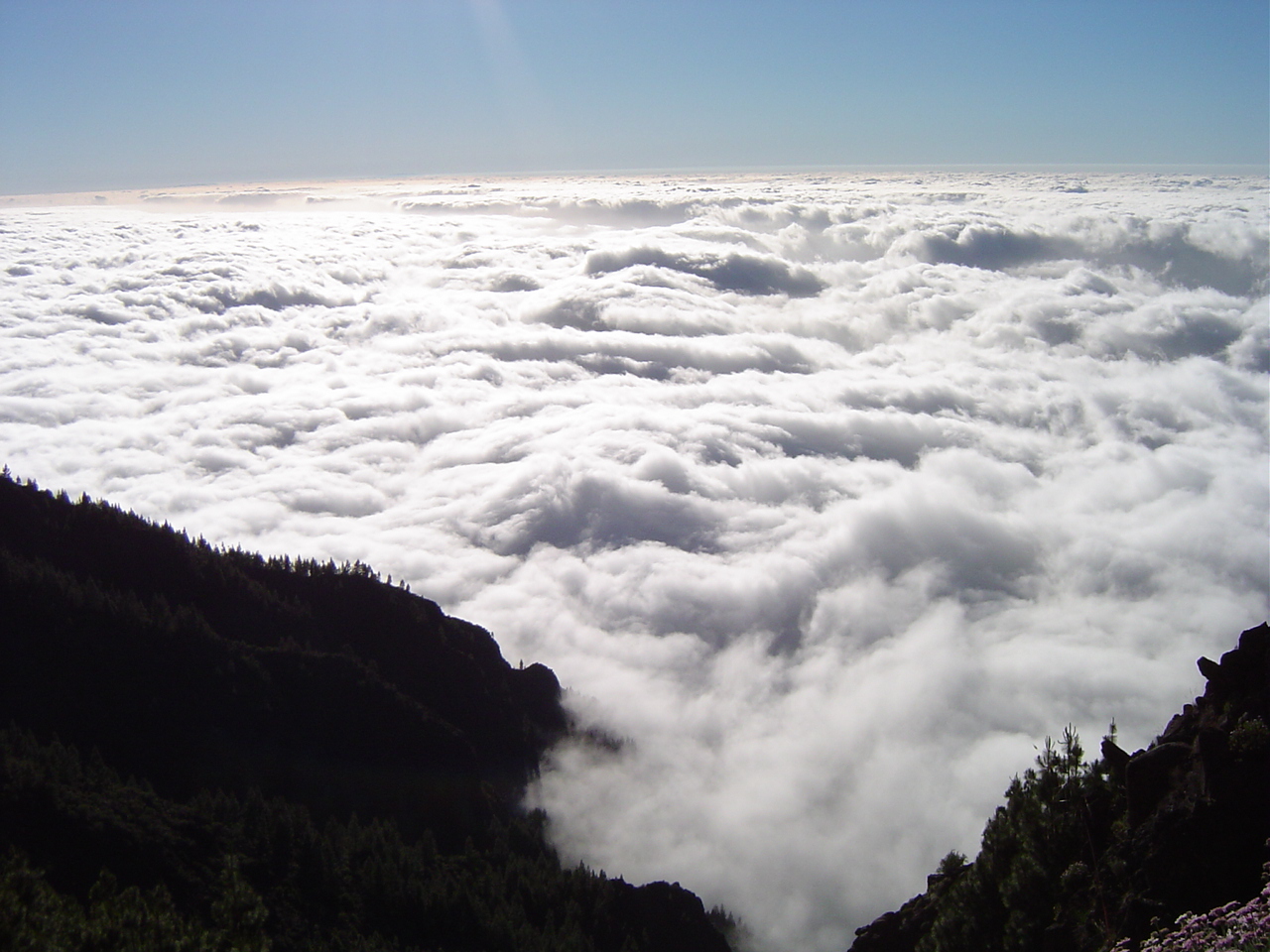
Few images of Tenerife captivate quite like the sight of a thick, white blanket smothering the north of the island whilst the south basks in brilliant sunshine. That phenomenon has a name: the sea of clouds. And it’s no accident or quirk of the weather. It’s the result of a chain of atmospheric and geographical processes that have been shaping the landscape, climate, and unique ecosystems of the Canary Islands for millions of years.
If you’ve been staying in Tenerife and spotted that cloudy horizon to the north whilst sunbathing on Costa Adeje, you’ve already witnessed the phenomenon firsthand. In this article, we explain what causes it, where to see it at its best, and why — from the air — it takes on an entirely different dimension altogether.
What Is Tenerife’s Sea of Clouds and Why Is It So Special?
The sea of clouds is no poetic metaphor. It’s a real, scientifically fascinating meteorological phenomenon that makes Tenerife one of the most spectacular natural settings on the planet.
It all begins with the trade winds — those warm, moisture-laden air currents that blow steadily in from the north-east Atlantic. As they collide with the island’s volcanic terrain, these winds push a mass of low cloud towards Tenerife’s northern slopes, where it becomes trapped by an atmospheric mechanism known as thermal inversion: a layer of warm air that acts as an invisible ceiling, preventing the clouds from rising beyond a certain altitude.
The result is a dense, white blanket covering the north of the island like an ocean suspended in mid-air. And above that ocean, rising with a breathtaking majesty, stands Mount Teide — the highest volcano in Spain and the third largest volcano in the world measured from its submarine base — commanding the horizon from its 3,715 metres.
That contrast — clouds below, blue sky above, and Teide standing sentinel — is what makes Tenerife’s sea of clouds truly one of a kind.
The Science Behind the Phenomenon: Trade Winds, Thermal Inversion, and Laurel Forest
To understand why this phenomenon is so consistent in Tenerife, you need to appreciate the island’s geography. The Anaga Massif to the north-east and the Teno Massif to the north-west act as natural barriers that hold back the clouds driven by the trade winds, concentrating them on the northern slopes and creating that suspended-sea effect.
But the sea of clouds is far more than a visual spectacle. It serves a vital ecological function: it generates what scientists call horizontal rainfall — an invisible form of precipitation in which water droplets from the clouds are captured by vegetation without ever falling as conventional rain. This silent moisture is what sustains two of the Canary Islands’ most precious ecosystems:
- The Laurisilva Forest — a relict forest from the Tertiary era that survived the ice ages thanks to the Atlantic climate of the Canaries, and now a UNESCO World Heritage Site.
- The Forest Crown — the green belt encircling Teide National Park, where the Canarian Pine, a unique species capable of surviving wildfires thanks to its thick bark, forms forests of austere and powerful beauty.
Without the trade winds, without thermal inversion, without the sea of clouds, these ecosystems simply would not exist. Every time you fly over Tenerife with Brisa, you’re soaring above millions of years of natural history.
Viewpoints for Watching the Sea of Clouds
From the ground, there are some outstanding vantage points from which to take in this phenomenon. Mirador de Chipeque, on the road climbing towards Teide, offers a head-on view of the cloud blanket covering the north. Mirador de La Tarta and Mirador de Ortuño let you peer right over the edge of the sea of clouds and feel the temperature shift sharply as you cross the boundary between the sunny south and the overcast north. And from Mirador de Las Cumbres, on the clearest of days, you can see the sea of clouds to the north and the glittering Atlantic to the south — simultaneously.
These are genuinely beautiful experiences. But there is a fundamental difference between watching the sea of clouds and flying above it.
Why Is South Tenerife the Best Place to Go Paragliding?
The south of Tenerife — and Costa Adeje in particular — enjoys exceptional weather conditions that make it one of the finest paragliding destinations in Europe. Whilst the north of the island may be shrouded in cloud, the south enjoys more than 300 days of sunshine per year, with trade winds providing consistent and stable flying conditions.
This means that if you’re staying in Costa Adeje, Las Américas, or Los Cristianos, you have one of the world’s best flying environments right on your doorstep — virtually all year round. At Brisa we fly six days a week, and our complimentary transfer service from your accommodation makes the logistics as straightforward as sending a WhatsApp message.
What’s Included in Your Flight with Brisa
When you book with Brisa, you’re not just booking an activity. You’re booking a complete, no-surprises experience:
- Complimentary transfer from your accommodation in Costa Adeje, Playa de las Américas, Los Cristianos, Playa Paraíso, or Callao Salvaje.
- Certified, latest-generation safety equipment: helmet, harness, knee pads, and gloves.
- Tandem flight with a certified pilot-instructor with over 25 years of international experience.
- Personalised service in your language: Spanish, English, French, German, Dutch, and Italian.
- Public liability insurance with coverage of €1,600,000.
- Optional GoPro photo and video package, transferred directly to your phone upon landing.
No prior experience required. No equipment needed. All you need is the desire to fly.
Ready to join us? Get in touch via WhatsApp or through the booking form on our website and take to the skies tomorrow. Places are limited, and Tenerife’s sky won’t wait.
Frequently Asked Questions About the Sea of Clouds and Paragliding in Tenerife
Can I see the sea of clouds from a paraglider?
It depends on the conditions on the day. In autumn and winter, when the phenomenon is most frequent, it’s quite common to see the cloud blanket covering the north of the island whilst the south remains clear. From the air, the perspective is absolutely unlike anything else.
Does the sea of clouds affect paragliding flights?
In most cases, no. The sea of clouds remains confined to the northern slopes of the island, whilst the south — where Brisa operates from Taucho, in Adeje — stays clear and sunny. In fact, days with a well-defined sea of clouds often coincide with particularly favourable thermal conditions for flying.
That said, every day is different. When the phenomenon extends southwards or the cloud cover affects visibility at the launch or landing site, the Brisa team assesses conditions before confirming the flight. Safety and the quality of your experience always have the final say. If the day isn’t right, we’ll contact you to reschedule at no additional cost.
What time of year is the sea of clouds most common?
The phenomenon is most frequent between autumn and winter, though it can appear at any time of year. The consistency of the trade winds ensures it remains a recurring feature of Tenerife’s skies.
Do I need prior experience to go paragliding?
Not at all. Tandem flights with Brisa are designed for people with no previous knowledge whatsoever. Your pilot-instructor takes care of everything — you simply sit back and enjoy the ride.
How long does the full experience last?
The full experience lasts approximately two hours, including the transfer, preparation, and the flight itself. Time in the air ranges from 15–20 minutes for the standard flight to 35–40 minutes for the extended flight.
How do I book?
The quickest way is via WhatsApp. You can also use the contact form on our website. At Brisa, we respond almost immediately — because we know that many of our passengers decide to fly today for tomorrow.
What happens if the weather isn’t suitable?
If weather conditions aren’t up to scratch, we’ll contact you to reschedule at no additional cost. Your safety and enjoyment are always our top priority.
Does the sea of clouds have any effect on the island’s natural environment?
Yes — and it’s absolutely fundamental. The clouds generate what is known as horizontal rainfall: water droplets are captured by vegetation without ever precipitating as conventional rain. This silent moisture sustains the Laurisilva Forest — a relict ecosystem from the Tertiary era and a UNESCO World Heritage Site — as well as the Forest Crown, where the Canarian Pine forms forests of austere beauty that simply would not exist without this phenomenon.
How long does the sea of clouds last?
There’s no fixed duration. It can persist for hours or even several consecutive days, particularly in autumn and winter. Its staying power depends on the strength of the trade winds and the stability of the thermal inversion. Generally speaking, it tends to be most stable during the middle of the day and may partially dissipate towards dusk.