

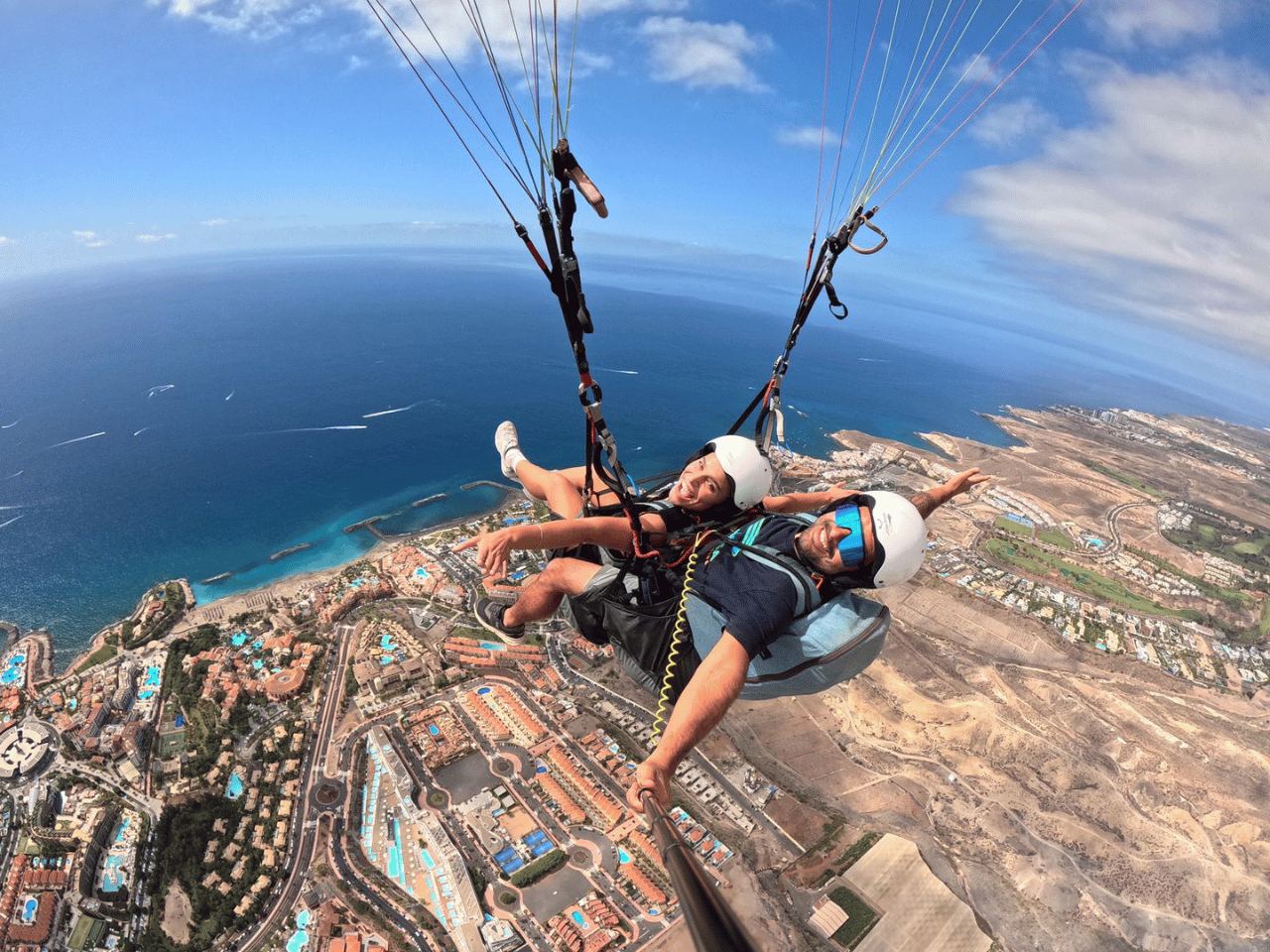
Have you ever wondered whether your weight might affect your paragliding experience? It’s one of the most common questions I receive. The good news is that paragliding is an inclusive activity that can be enjoyed by a wide variety of people, provided certain safety parameters are respected.
At Brisa Paragliding, we’ve accompanied thousands of passengers of different builds on this unique adventure above Barranco del Infierno and Costa Adeje. Each flight reminds us that the magic of paragliding knows no sizes or weights—only dreams and the courage to make them reality.
Is There a Weight Limit for Paragliding?
Yes, paragliding does have specific weight limits, but not for the reasons many imagine. These limits aren’t arbitrary or discriminatory; they’re essential technical parameters that guarantee safety and optimal aircraft performance during flight.
In our operations in South Tenerife, we set a minimum weight of 25 kg and a maximum weight of 100 kg for tandem flights. These limits have been carefully established after years of experience flying in the specific conditions of our island, where the trade winds and thermal currents create a unique environment for free flight.
The physics of flight teaches us that each paraglider is designed to operate within specific total weight ranges. When I speak of total weight, I’m referring to the combined weight of the passenger, the pilot-instructor, the equipment and the wing itself. This combination must maintain perfect balance for the paraglider to take off safely, remain stable during flight and execute a smooth landing.
How Much Weight Can a Paraglider Support?
The load capacity of a tandem paraglider varies according to the model and manufacturer’s specifications. In our case, we use state-of-the-art aircraft less than a year old, specifically designed for tandem flights in free flight conditions.
Our tandem paragliders can support up to approximately 200 kg of combined total weight, including pilot-instructor, passenger and equipment. However, the passenger’s specific weight must be maintained within the range of 25 to 100 kg to guarantee the best flight conditions.
This limitation isn’t exclusive to Brisa Paragliding; it’s an international standard in the tandem paragliding industry. Wing manufacturers certify their products for specific weight ranges, and staying within these parameters is fundamental to:
- Guarantee predictable aircraft behaviour
- Maintain stability during manoeuvres
- Ensure adequate responses to meteorological conditions
- Provide safety margins in unforeseen situations
Is There a Weight Limit for Tandem Paragliding?
Absolutely. Tandem flights (or biplaza, as we call them in Spain) have even more specific weight limits than individual flights. This is because in a tandem flight, the pilot-instructor must maintain total control of an aircraft carrying two people.
In our tandem flights over South Tenerife, the 100 kg limit for the passenger is established considering several critical factors:
Flight dynamics: The pilot-instructor needs to be able to control the wing effectively during all phases of flight. Excessive passenger weight can compromise this control capacity, especially during take-off from our launch site in Taucho, at approximately 800 metres altitude.
Tenerife-specific conditions: The trade winds and thermal currents of the Canary Islands create unique flight conditions. Our weight limits are specifically calibrated for these local meteorological conditions, guaranteeing that each flight makes the most of the ascending currents.
Safety equipment: Each harness, helmet and safety system is dimensioned for specific weight ranges. Maintaining these limits ensures that all equipment functions according to the manufacturer’s specifications.
Minimum Weight Requirements for Paragliding
The lower weight limit is as important as the upper one, though it’s often overlooked. At Brisa Paragliding, we set a minimum weight of 25 kg for passengers, and this decision is based on very specific technical and safety considerations.
Why Respecting the Minimum Weight Is Necessary
Minimum weights aren’t a formality; they’re essential for flight safety for several fundamental reasons:
Wing stability: A paraglider needs a minimum load to maintain its correct aerodynamic shape. With insufficient weight, the wing can collapse more easily with minor turbulence, compromising flight safety.
Control during take-off: At our launch site in Taucho, take-off requires a brief coordinated run between pilot-instructor and passenger. A very light weight can cause the passenger to be “lifted” prematurely by the wing, before the proper running rhythm has been established.
Response to commands: During flight, especially in the variable thermal conditions of South Tenerife, we need the wing to respond predictably to our commands. Insufficient weight can make these responses too abrupt or unpredictable.
Special Considerations for Beginners and Light Passengers
If your weight is at the lower end of our range (near 25 kg), don’t worry. We’ve developed specific protocols to ensure your experience is as safe and exciting as any other passenger’s.
For lighter passengers, especially children who meet the minimum weight, we adapt our flying technique:
Assisted take-off: We provide additional assistance during the take-off run to ensure a smooth transition from ground to air.
Condition selection: We choose days and times with gentler thermal conditions for flights with light passengers, avoiding unnecessary turbulence.
Constant communication: We maintain continuous communication throughout the flight to ensure passenger comfort.
Remember that at Brisa Paragliding we’ve flown with passengers of all builds. The key lies in the professional adaptation of our techniques to each person’s specific characteristics.
Does Clothing and Equipment Count Towards the Weight Limit?
This is a very practical question we receive frequently, especially from visitors who come to Tenerife during the winter season. The answer is: it depends on the type of equipment.
Personal clothing: The clothing you’re wearing (which must include long trousers and trainers for safety) does count towards your total weight. However, we’re talking about minimal differences that don’t significantly affect weight calculations.
Safety equipment: All the safety equipment we provide (helmet, harness, knee pads, etc.) doesn’t count towards your personal weight limit. This equipment is included in our operational calculations and forms part of the operation’s standard weight.
Personal items: For safety reasons, carrying external equipment during the flight (cameras, phones, rucksacks, etc.) isn’t permitted. This not only guarantees your safety but also eliminates additional weight variables.
In practice, when we carry out the pre-flight weight assessment, we consider your body weight plus the clothing you’re wearing. Seasonal variations in clothing are minimal and are covered within our safety margins.
Can Weight Limits Vary According to Location or Provider?
Yes, weight limits can vary between different providers and locations, and there are very valid technical reasons for these differences. In the case of Brisa Paragliding in South Tenerife, our limits are specifically calibrated for the unique conditions of our operating area.
Local meteorological conditions: South Tenerife offers some of the best flight conditions in Europe throughout the year, but these conditions have specific characteristics. The trade winds, thermal currents and coastal landing conditions require specific adjustments to operational limits.
Take-off altitude: Our take-off point in Taucho is situated at approximately 800 metres altitude. Air density at this altitude affects wing performance and therefore influences optimal weight limits.
Team experience: Experience in flying guarantees safety and flight quality: that’s why Brisa’s instructors have over 20 years of experience under their belts.
Specific equipment: We use tandem wings less than a year old, selected specifically for South Tenerife conditions. Each wing model has its own certified weight ranges.
It’s important to understand that more restrictive limits don’t necessarily mean lower service quality; they can indicate greater specialisation and adaptation to specific local conditions.
Your Paragliding Flight Is Waiting for You
Weight limits in paragliding shouldn’t be a barrier to living one of the most exciting experiences of your life. With such a broad range (25-100 kg), the vast majority of people can enjoy the magic of flying over the spectacular landscapes of South Tenerife.
At Brisa Paragliding, each enquiry about weight is handled personally. If you have doubts about your eligibility to fly, we invite you to contact us directly. Our multilingual team can assist you in Spanish, English, French, German, Dutch or Italian, providing you with accurate information about your specific case.
Remember that we offer free transfer from your accommodation in Costa Adeje, Playa de las Américas, Los Cristianos, Playa Paraíso and Callao Salvaje. During the journey to our take-off point, we’ll resolve any doubts you might have about the technical aspects of the flight.
Don’t let questions about weight postpone your dream of flying. Contact us via WhatsApp or through our web form to confirm your eligibility and book your place on this unique adventure. The Tenerife sky is waiting to give you a completely new perspective of the Canary Islands.
Are you ready to discover why thousands of adventurers from around the world choose Brisa Paragliding to live their first free flight experience? Your adventure in the heights is just one booking away.